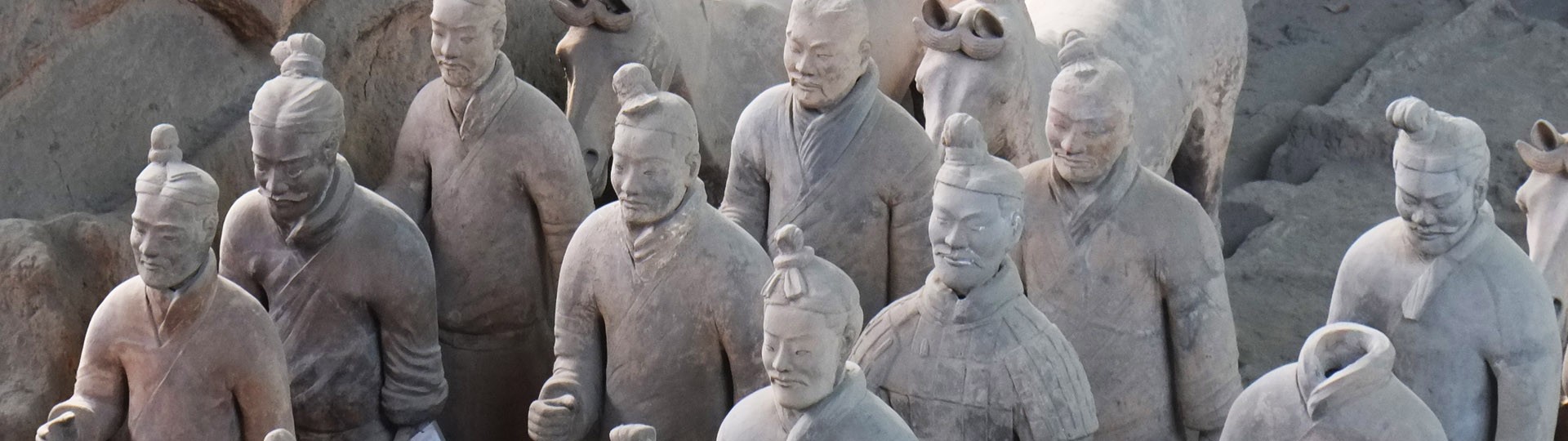
The buried army of Qin Shihuangdi is one of the largest and most stunning
archaeological finds of the 20th century. Discovered in 1974 at Lintong, 35 kilometres
east of Xi'an, the warriors and horses have deservedly become known as a Wonder
of the World. Now exhibited in situ, the life-size terracotta figures so far excavated
testify to the power of the man for whom they were moulded to protect in afterlife.
This site is an archaeological find on a monumental scale. Literally an army of sculptured warriors, it is a stunning display that every visitor to China should see.


The terracotta soldiers are remarkably realistic pieces of sculpture. Each soldier's face has individual features, prompting speculation that they were modelled from life. They have square faces with broad foreheads and large, thick-lipped mouths, and they wear neat moustaches, and a number have beards. Some of them have their hair in a topknot. Expressions are generally austere, eyes focused far ahead. It is sobering to study the rows of soldiers and to compare not just their facial features, but also their varying heights, hairstyles, even the differences in the folds of their scarves, and to consider the amount of work that went into making them. The figures stand between 1.72 and 2 metres (nearly 5 feet 8 inches and 6 feet 7 inches) tall. The body, arms and legs are hollow and were formed by looping coils of clay into a kind of tube and then beating them together whilst placing a hand inside for support. This technique has been substantiated by the discovery of fingerprints and paddle marks on broken statues. The head and hands are solid and were moulded separately and fitted to the body after firing. A thin layer of clay was applied to each head and the individual features hand-sculpted. Details of the armour were also added to the body by hand.
The statues were originally painted using pigments made from minerals mixed with a binder such as animal blood or egg white. But the colour has been almost entirely lost save for a few traces of red on tassels decorating armour and flakes of pigment on some of the faces.

The soldiers are divided into infantry armed with swords and spears, archers, crossbow archers, cavalry, chariot drivers, officers and generals. The wooden chariots no longer exist, having decayed over the centuries, but imprints of parts of them, especially wheels, remain visible in the compacted soil and their metal fittings have been excavated. Each chariot was drawn by four pottery horses, on average 1.5 metres (4 feet 11 inches) tall by 2 metres (6 feet 7 inches) long. The terracotta troops bear real arms, made of bronze. A huge number have been unearthed: swords, daggers, billhooks, spears, halberds, axes, crossbow triggers and arrowheads. The copper-tin alloy used was combined with 11 other elements such as nickel, magnesium, cobalt and chrome, and many weapons have emerged sharp, shiny and untarnished. The arrowheads contain a poisonous percentage of lead.
The vault housing the warriors was originally a five-metre (16 feet) deep pit with foundations of rammed earth. Three-metre (ten feet) high walls formed chambers which were paved with bricks. Pillars lining the pits supported pine-log beams and these in turn were overlaid with thick wooden planks, covered with reed mats and finally loess clay.
The terracotta soldiers, horses and chariots were arranged inside. Rut marks are still visible on some of the original slopes down which the army was wheeled. The enclosure was then permanently sealed, or at least that was the intention. It appears, however, that the troops of General Xiang Yu, who had already plundered the nearby imperial tomb, Qin Ling, opened the vault in 206 BCE and set fire to the roof, which collapsed, smashing the figurines in site and preserving them in mud and ash.

This pit, the first of three that were discovered over the period from May 1974 to June 1976, forms the main exhibition hall at the Qin Terracotta Army Museum complex. It is a rectangular pit measuring 230 metres in length from east to west and 62 metres in width from north to south. Extensive excavation in the eastern half of this pit has so far revealed 1,087 warriors, 32 horses and the traces of eight chariots.
The display consists of infantry and charioteers arranged in battle formation. It consists of 11 parallel corridors running east to west, each corridor being 210 metres (230 yards) in length. The vault covers a total area of 14,260 square metres (17,055 square yards). So far, over 1,000 soldiers have been restored to standing position, in columns four abreast, standing on the original brick floor. At the head, facing east, is the vanguard, consisting of three rows of 70 archers each. They are followed by 38 columns of more heavily armoured infantry interspersed with some 40 war chariots, of which only the pottery horses remain. The south and north flanks are defended by single column of spearmen facing outwards, some clothed in battle dress, others in armour and holding weapons, while more warriors on the west flank form the rearguard. In the centre of the formation the warriors are lined up in nine columns, and among them are interspersed impressions of eight wooden chariots, now decayed. Each chariot is drawn by four horses and would have borne a driver and two warriors.

Continuing down the northern flank of the vault you see corridors sometimes covered in protective plastic, and you may occasionally catch a glimpse of a halfexcavated terracotta warrior, looking as if he was drowned in a sea of brown mud. At the unexcavated western end of the pit stand many half-reconstructed soldiers. Here it is often possible to observe archaeologists as they attempt to piece together the thousands of fragments of this enormous jigsaw. As it is unearthed, each piece is coded, marking where it was found and to which statue it might belong. Visitors exit the vault through a small door in the northwest corner. Archaeologists have estimated that if completely excavated the pit would yield more than 6,000 warriors, 160 horses and 40 chariots.

Twenty metres (22 yards) northeast of Pit Number One, this L-shaped pit was discovered in 1976 after extensive test drilling, but the official excavation did not begin until March 1994. Whereas Pit Number One contains mainly infantry, Pit Number Two has a greater number of archers, chariots and cavalrymen leading their horses- housing around 900 soldiers, including kneeling and standing archers, infantrymen and charioteers, together with some 350 chariot horses, 116 cavalry horses and the remains of 89 wooden chariots.


Excavations are only at a very early stage. Archaeologists think that the pit might hold a total of 1,300 figures, more than 450 horses and the traces of 89 battle chariots.

Discovered just one month after Pit Number Two, Pit Number Three lies 25 metres (27 yards) to the northwest of Pit Number One. It is U-shaped and only 28.8 metres (31.5 yards) in length from east to west, 24.6 metres (27 yards) in width from north to south and covering an area of less than 500 square metres (598 square yards).
Though the smallest of the three pits, Pit Number Three is strategically the most important since the command of the entire terracotta army was stationed here.
Excavation of this battle headquarters has revealed the traces of a chariot, four horses and 68 warriors. The four horses pulling the chariot and the four warriors behind it are in good condition, but many of the pit's other figures are headless or smashed completely. Numerous bronze weapons, and fragments of deer horn and animal bone have also been found. Animal sacrifice was probably part of the rites performed by commanders of a real army, who would have prayed to the gods for victory before a battle.


The figures are all quite tall, with generals and commanders being the tallest and most portly. Apart from their larger size, generals can be clearly identified by their double-tailed headgear, longer tunics falling to below the knee, and minimal fishscale pattern armour on the midriff, which hangs in an inverted V-shape a little below the waist. On the chest and neck they have bow-like decorations, while their feet are shod in boots with upturned toes. The sleeves of generals' tunics are usually long enough partly to cover the hands, since generals directed their troops and rarely engaged in direct combat themselves.

Cavalrymen are found dismounted in front of their terracotta horses. They can be recognized by their sleeveless jackets of armour, which appear thick, and are composed of quite large, squarish plates that seem to be riveted together. Headgear is extremely simple and close-fitting and is secured with a chin strap to prevent it blowing off while riding. Shoes are the lightest and smallest of all those worn by the army.

The infantry wear either battle robes or bulkier armour. Their hair is usually tied into topknots and their hands are poised to carry spears. The charioteers are in more active poses. They have both arms stretched out slightly so as to hold the reins to drive their vehicles. Their horses, approximately 1.72 metres in height and slightly over 2 metres in length, look sturdy with big, bright, alert eyes, wide-open nostrils and impressive muscularity.

The warriors are composed of baked clay that was made by mixing loess with quartz sand. Anatomical parts the heads, ears, torsos, arms, hands, legs and feet were moulded separately. Individual adornments, such as hats, hair, tunics, armour and gaiters, were then moulded onto completed bodies from sheets of clay. At this stage the art of the craftsmen came into play as individual characteristics were produced, or perhaps copied. Some of the more delightful fine personal touches include the furrows on a general's forehead and the smile of a young warrior.

BRONZE CHARIOTS AND HORSES
Two magnificent bronze chariots are housed in a relatively new exhibition hall, which stands to the right or north as you first enter the museum complex. In August 1978, archaeologists unearthed a small gold ornament the size of a walnut, some 20 metres (22 yards) to the west of the emperor's tomb, Qin Ling. Two years later in December 1980, two chariots, each with two-spoked wheels and drawn by four horses, were unearthed-totally smashed, apart from the solid bronze steeds and charioteers. Horsepower to weight ratio suggests that both these vehicles could have covered ground fairly swiftly.

The two bronze chariots were certainly crafted specifically for Qin Shihuangdi's afterlife. Since excavation they have been successfully pieced together. The chariots were originally placed one behind the other facing west in a wooden coffin about 7 metres (23 feet) long and 2.3 metres (7.5 feet) wide. The larger of the two chariots, the anche, weighs 1,241 kilograms (2,736 pounds), and at 2.86 metres (9.38 feet) in length, and 1.07 metres (3.51 feet) in height, it is thought to be half the size of an actual chariot. It is made of bronze, gold and silver components- about 3,462 separate metallic parts in all. It has a closed carriage with small, sliding, rhombusshaped lattice windows on three sides for ventilation, and a door at the back. The domed roof, symbolizing the round sky, is of very thin bronze sheeting laid over a frame of 36 bowshaped spokes (corresponding to the number of districts in the Qin Empire) which are about 6 millimetres in diameter. It covers the passenger carriage and the seated charioteer, which is also made of solid bronze. Stylized clouds are painted on the interior ceiling and include dragon and phoenix patterns and, based on silk fragments discovered inside, it is thought some accessories-maybe cushions or quilts-had once made the royal passenger comfortable. This predates the more widespread use and export of silk by several centuries. The chariot therefore seems likely to have been crafted specifically for Qin Shihuangdi's afterlife, although it is thought he used such a vehicle for his inspection tours.
Called wenliangche, the chariot was the limousine of its day.
The second chariot, the gaoche, which was found in front of the other, may have been a vanguard vehicle with no covered compartment. It is also called liche, a battle chariot, and like the second, is drawn by four horses. At 2.25 metres in length and weighing 1,061 kilograms, it is smaller and lighter than the anche, but it has the same number of horses. With its greater power to weight ratio this was a swifter vehicle and would have run ahead of the anche as an escort. There is no compartment in the vanguard chariot; to accommodate the standing driver the canopy is correspondingly much higher than that of the wenliangche-1.68 metres (5.5 feet) high-and displays superb gold decorative work on the post of the umbrella, which is locked in place by a special key. The chariot carries a pair of bronze shields, a crossbow and arrow, and a box containing 66 bronze arrowheads. The total weight of the first chariot is 1,061 kilograms (2,339 pounds) and consists of 3,064 components.
Both chariots highlight the superb metallurgical and metalshaping technology of the Qin period as well as its highest artistic standards. Most chariot fittings are of solid bronze, often painted, although their pigments have faded. The harness and reins are inlaid with gold and silver, and each horse wears a halter made of some 84 one-centimetre (0.4-inch)-long tubes, fitted one onto another and thus endowed with a flexibility close to rope or leather.
A tassel hangs down from each horse's neck. The canopies are incredibly thin bronze sheets but their casting is even and smooth. They are laid over a frame of 36 bowshaped spokes about six millimetres (0.24 inches) in diameter. All these dimensions suggest to the archaeologists that both the temperature control and the casting methods were by this time highly advanced. Many parts of the chariots are overlaid with chains fashioned from extremely fine copper wire, with some of the strands just 0.5 millimetres (0.02 inches) in diameter. Microscopic examination shows that these strands were not forged but were drawn out to this size before being welded into rings and chains. The chariot drivers and horses are also of solid bronze, yet despite their material they appear lifelike. Artisans probably used files on the figures to reproduce the appearance of hair. The horses, painted white to mimic hide and given realistically flared nostrils, convey the impression that they are ready to stride forth at the crack of the charioteer's whip.
The other artefacts exhibited in this hall include more recently unearthed treasures such as the ten terracotta wrestlers and entertainers, 80 pieces of stone armour and a 212 kilogram (467 pound) bronze tripod vessel (ding). The life-size terracotta figures are carefully and realistically modelled. One of them, a headless stocky figure whose upper body is naked and who has muscular arms, holds what might be a pole used for acrobatics in his hands, which are placed in front of his protruding belly. When looked at in detail, the skirt is embellished with geometric designs. Another one of these figures, who might have also been part of a troop of acrobats, wrestlers or entertainers, stands with his right arm raised above his head. It is thought that he might have been holding a weight. These are the earliest evidence found to date of the careful observation of the human body and the ability to recreate it in clay. In 1998, during a test excavation 150 metres to the southeast of the emperor's tomb mound, archaeologists came across thousands of pieces of stone. Not actually unearthed until August 1999, they included 80 pieces of stone armour. Found scattered in a pit, thousands of pieces of grey limestone plates, each bevelled and drilled with holes, were painstakingly reassembled to their original shapes. They were strung together with copper wire in a fish-scale formation similar to that sculpted on the terracotta warriors and characteristic of later Han-dynasty iron armour. Archaeologists have also been able to piece together stone helmets in the same way. One set of this ceremonial armour and helmet together weighs 20 kilograms (45 lbs). Work at this and other digs is continuing and is likely to yield yet more discoveries.
For more information and for a list of worldwide distributors please visit Odyssey Publications web site